

Strategy
Part of Digital PR strategy planning and delivery explained
Digital PR channel strategy: four distribution routes and their source burden
An overview of four digital PR distribution routes, the source types each needs, illustrative costs, measurement and how to set a split against client objectives.
What to take away
- Pick the distribution route first, then buy the data it needs. Starting with sources locks you into a channel.
- Earned media suits original datasets and expert commentary, but needs the widest source list and the longest lead time.
- Sponsored placements buy reach quickly, yet they need audience data to justify the spend.
- Score every route on cost, control, source burden and measurement before allocating budget.
Comparing the four distribution routes
Earned coverage through proactive outreach
Earned coverage depends on a story a journalist cannot get elsewhere: a dataset you built, a freedom of information request you processed, or a named expert with a defensible view. The source burden is high, because you need raw data, a method note and a named contact at each target publication.
Earned vs Sponsored Distribution
Earned coverage
- Source burden
- High
- Control over timing
- Low
- Lead time
- 6-10 weeks
- Legal duties
- ICO checklist
Sponsored placements
- Source burden
- Medium
- Control over timing
- High
- Lead time
- Guaranteed placement
- Legal duties
- Platform specs
Outreach carries legal duties. The ICO direct marketing checklist sets out consent and opt-out expectations for electronic messages to organisations and individuals, and it applies to press pitches sent at volume.
Lead time is the hidden cost. A data-led pitch can run six to ten weeks from idea to coverage, because the dataset must be built, checked and briefed first. A client expecting coverage inside a fortnight will read that gap as failure.
Sponsored placements and syndication
Paid distribution trades editorial judgement for guaranteed placement. LinkedIn sponsored content is the clearest example, and the platform describes it as a native advertising format, so the reach is bought rather than earned. Read the LinkedIn sponsored content specification before you promise a client coverage numbers.
Syndication through trade titles works the same way: you supply the asset, the publisher supplies the audience, and link value depends on the outlet's policies. The data requirement is audience sizing, not story data.
Ask a publisher for its sponsored content policy in writing before you book. That document settles most later disagreements about disclosure and link placement.
Owned and social amplification
Owned channels carry no placement risk and no outreach cost. They also carry no third-party endorsement, which is why they rarely satisfy a client who asked for links. Use owned channels to host the underlying asset, then point outreach and paid distribution at it.
Social amplification sits between the two: a genuinely novel asset can be shared organically well past launch week.
What each route costs to sustain
Budget and effort compared
Typical monthly cost (illustrative)
- Earned outreach
- £2,000 to £6,000
- Sponsored placements
- £1,500 to £8,000
- Syndication
- £500 to £3,000
- Owned and social
- Under £500
Effort per asset
- Earned outreach
- 15 to 30 hours
- Sponsored placements
- 5 to 10 hours
- Syndication
- 3 to 6 hours
- Owned and social
- 4 to 8 hours
Source burden
- Earned outreach
- High: original data plus contacts
- Sponsored placements
- Medium: audience data
- Syndication
- Low to medium
- Owned and social
- Low
Control over timing
- Earned outreach
- Low
- Sponsored placements
- High
- Syndication
- High
- Owned and social
- High
Figures are illustrative planning examples, not market rates. A team paying £400 a month for one sponsored slot is buying reach, not authority.
Route Costs and Effort
Earned outreach
- Monthly cost
- £2k-£6k
- Effort per asset
- 15-30 hrs
- Source burden
- High
- Timing control
- Low
Sponsored placements
- Monthly cost
- £1.5k-£8k
- Effort per asset
- 5-10 hrs
- Source burden
- Medium
- Timing control
- High
Syndication
- Monthly cost
- £500-£3k
- Effort per asset
- 3-6 hrs
- Source burden
- Low-medium
- Timing control
- High
Owned and social
- Monthly cost
- Under £500
- Effort per asset
- 4-8 hrs
- Source burden
- Low
- Timing control
- High
Measurement and reporting
Each route needs a different measurement frame. Earned coverage is judged on referring domains and brand mentions. Paid routes are judged on impressions, clicks and cost per placement. Owned routes are judged on assisted conversions.
Reach across channels is not directly comparable, which is why methods such as Nielsen's cross-media measurement approach exist. If you claim combined reach in a client report, name the method behind the number.
How to score the trade-offs
Build the source list before the budget line
Map the sources each route needs before costing it. Earned outreach needs original data, expert quotes and a media contact list. Paid routes need audience sizing and placement pricing.
If you cannot name the sources, you cannot cost the route. Use the digital PR planning template for data and sources to record each source, its owner and its refresh date before you commit spend.
Refresh dates matter as much as owners. A dataset that goes stale after six months needs a named person to update it, otherwise the asset supports one campaign only.
Set the split against the client objective
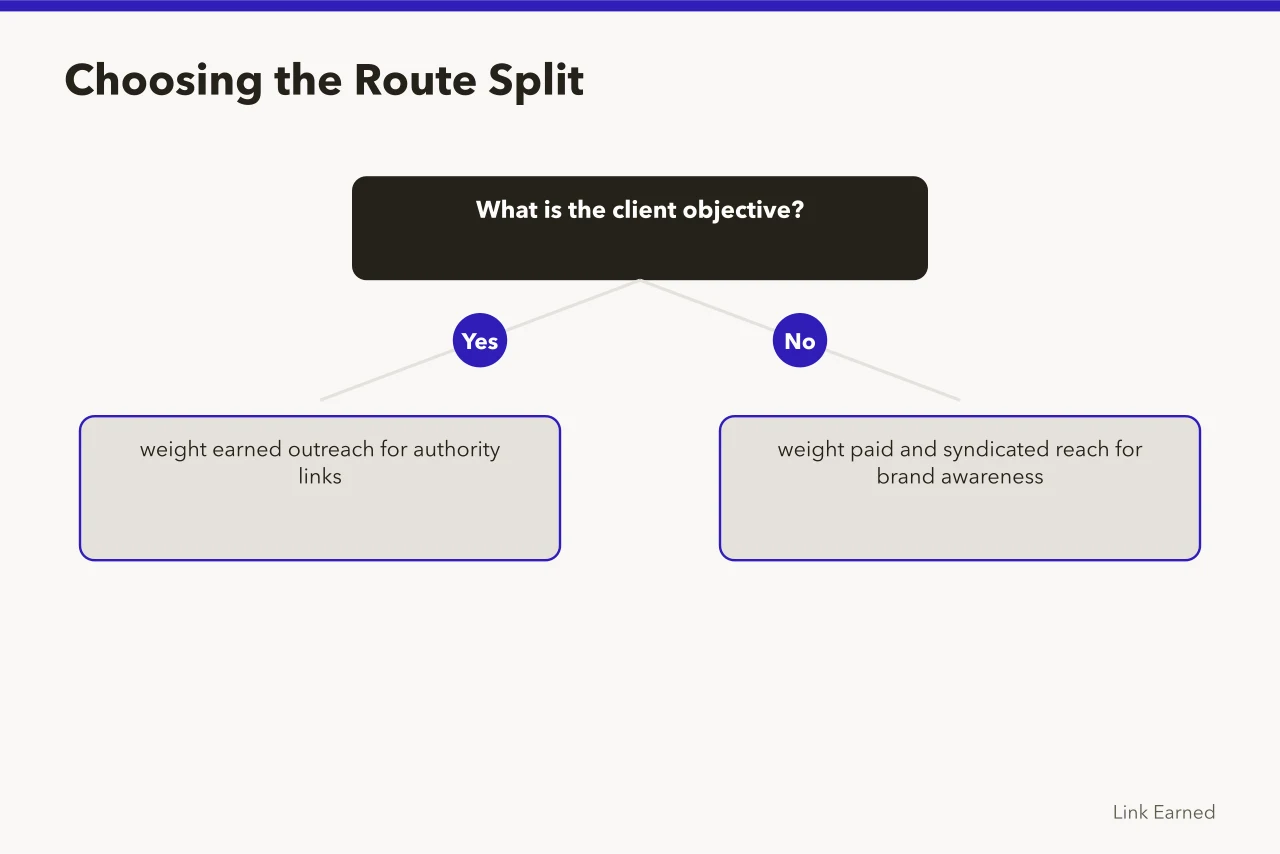
A client chasing authority links should weight earned outreach. A client chasing brand awareness should weight paid and syndicated reach. Most programmes run two routes, not four, because splitting effort too thinly weakens both.
Two routes is usually the ceiling for a mid-sized team. Beyond that, both routes slow down and the reporting gets harder to defend.
Channel choices also have to sit inside a wider plan. The digital PR strategy and planning guide shows how they connect to objectives, timelines and reporting cycles, which is worth reading before you sign off a twelve-month budget.
Common questions
Which channel should a first digital PR programme start with?
Start with earned outreach if the client wants links, because it produces the assets other routes later amplify. Add one paid route once the earned process is repeatable.
Do paid placements count as digital PR?
They count as distribution, not earned coverage. Report them separately so a client can see which results were bought and which were won.
How many data sources does a channel strategy need?
Enough to name the source behind every claim you make in a pitch or a report. If a figure has no source, remove it or label it as an illustrative example.