

Reviews
How to run digital PR reviews and compare agencies
A working guide to running digital PR reviews: how to compare agencies and tools, score them against evidence, and check suppliers before you sign a retainer.
What to take away
Digital PR reviews are structured assessments of agencies, freelancers or software that earn editorial coverage and links for a brand. Treat the review as a buying decision, not a beauty parade.
- Score every supplier on the same weighted criteriacoverage quality, links earned, transparency, reporting and contract terms.
- Ask for raw data you can check, such as campaign URLS, referring domains and date-stamped reports, rather than summary slides.
- Run corporate and regulatory checks before signing, including PSC records, supplier compliance evidence and consent practices.
- Compare on cost per placed link and cost per referring domain, not headline retainer size.
- Re-review annually, or sooner when your target publications change.
Why a repeatable review beats a beauty parade
Most buyers choose a digital PR supplier from a pitch, a referral or a directory ranking. None of those give you a comparable score. A pitch rewards presentation. A referral tells you one client was happy. A directory ranking often reflects how much the supplier pays for placement.
Five parts of a review
- Write the brief first
- Define weighted criteria
- Collect the evidence pack
- Score independently
- Record the decision
A repeatable review fixes the comparison. You define the criteria before you speak to anyone, weight them, then collect the same evidence from each supplier. That way a smaller agency with strong regional media contacts can beat a large one with a polished deck.
The review itself has five parts: the brief, the criteria, the evidence pack, the score and the decision record. Skipping any one of them leaves you defending a hunch. Write the brief first, because it determines what evidence you ask for.
Define the outcome you are buying before you define the supplier type. Coverage volume, link acquisition and share of voice each need different measurements, and a supplier that excels at one may be weak at another.
Set a review owner and a deadline. Reviews stall when they sit with a committee. One person collects the evidence, one or two others score independently, and the buyer makes the call. A fortnight is usually enough for three suppliers once the evidence template is fixed.
If you are reviewing tools rather than people, the same logic applies. A media database, a journalist request platform and a monitoring suite solve different jobs. Scoring them on one list usually produces a muddled answer, which is why a side-by-side digital PR product comparison in England is worth running before you shortlist.
What should you score a digital PR supplier on?
Coverage quality
Judge where coverage appeared, not how much. A placement in a trade title your buyers read is worth more than twenty syndicated mentions on sites nobody visits. Ask for the publication name, the URL, the date and whether a link was included.
What to score suppliers on
- Coverage qualitywhere, not how much
- Links earnedfollowed, nofollowed, domains
- Relevance of the media list
- Transparencyhow failures are reported
- Reporting and access to raw data
Look at the spread too. Twenty placements in one outlet suggest a single relationship rather than a media strategy. A mix of national, regional and trade titles is usually a healthier sign.
Links earned
Ask how many links were followed, how many were nofollowed, and which domains they came from. A link from a national news site and a link from a low-quality aggregator are not the same asset. Check a sample yourself rather than trusting a dashboard.
Relevance of the media list
Ask to see the media list used for your brief, or at least a representative sample. If it contains journalists who left two years ago, or titles outside your market, the outreach will underperform however good the writing is.
Transparency
A supplier should tell you what failed. Campaigns that earned nothing still cost money. Ask what proportion of pitched campaigns landed coverage in the last year and how they report a miss.
Reporting and access
You want access to the underlying data: the media list, the outreach emails and the coverage log. If the supplier owns all of it and shows only a monthly PDF, you cannot audit the work or take it in-house later.
Contract and exit terms
Check notice periods, ownership of assets and whether you keep the links if you leave. Long lock-ins with no performance break are a warning sign. So is a contract that gives the agency ownership of creative assets it produced with your budget.
How do you compare quotes fairly?
Convert every quote to the same unit. The three metrics that matter most are cost per placed link, cost per referring domain and cost per hour of senior time.
Quote comparison units
Metric
- Cost per placed link
- Fee divided by links
- Cost per referring domain
- Fee divided by domains
- Cost per senior hour
- Fee divided by hours
- Inclusions
- Database, design, reporting
- Fee structure
- Fixed or performance-linked
- Term length
- Pilot versus retainer
What to convert
- Cost per placed link
- Cost per referring domain
- Cost per senior hour
- Inclusions
- Fee structure
- Term length
For example, £3,000 a month for six placed links is £500 per link. A £6,000 retainer for twenty links is £300 per link. These are illustrative figures, not market rates.
Ask what is included. Some retainers bundle media database access, design and reporting. Others charge separately. A cheaper quote can end up costing more once you add the missing pieces.
Watch for quotes that hide the cost of design, data or freelance photography. Ask for the rate card behind the number, then check the hours implied by the fee against the deliverables promised.
Check whether the fee is fixed or performance-linked. A base retainer with a bonus for agreed outcomes can align interests, but it only works if the outcome is measurable and both sides agree how it is counted.
Compare like with like on time too. A three-month pilot and a twelve-month retainer are different products. Ask what the supplier expects to deliver in month one, month three and month twelve.
Our guide to digital PR costs and budget guide for England sets out the cost lines to put in your comparison sheet so quotes are genuinely like for like.
Which due diligence checks should you run before signing?
The checks below take an afternoon and prevent most supplier problems.
Due diligence checks
- Companies House filing history
- People with significant control
- Supply chain and ethical standards
- ASA rulings database search
- Industry certification evidence
Corporate checks
Look up the company on Companies House and review its filing history. Check the people with significant control to confirm who actually owns and controls the business, since this affects who you can hold to account if the relationship sours. GOV.UK publishes guidance on people with significant control that explains what the register shows and how to read it.
Supplier compliance
Ask for evidence of how the supplier manages its own supply chain, subcontractors and ethical standards. BSI sets out supplier compliance and excellence criteria that give you a sensible frame for those questions, even if the agency is far too small to hold formal certification.
Advertising standards history
If the supplier runs paid campaigns alongside earned coverage, check whether its work has been the subject of complaints. The ASA rulings database is public and searchable, and a repeated pattern of upheld rulings tells you something about how the agency treats claims.
Industry certification
Ask whether the supplier holds recognised industry certification. The IAB UK Gold Standard letter is one example of a scheme that signals a baseline commitment to media quality and transparency.
Data and consent
Digital PR involves emailing journalists and sometimes consumers. Check the supplier understands consent and opt-out rules. The ICO's hub on direct marketing and privacy and electronic communications is the starting point for UK electronic marketing rules, and a supplier should be able to explain them in plain terms.
References and financial health
Ask for two references from clients who left. Most buyers only speak to current clients, who have an obvious reason to be positive. A former client will tell you how the agency handled a bad quarter.
Check the filing history for signs of distress as well. Late accounts, a shrinking balance sheet or a sudden change of directors all matter when you are about to commit to a twelve-month retainer.
How do you verify the data suppliers give you?
Never accept a coverage report at face value. Pick five links at random and check each one. Does the page load? Is the link live? Is it followed? Would you be happy to be associated with the site?
Verifying supplier data
- Pick five links at random
- Check page loads and link is live
- Confirm followed or nofollowed
- Check domain in third-party tool
- Set sample size before starting
- Repeat the check ninety days later
Check the referring domain in a third-party tool rather than the supplier's dashboard. Discrepancies usually come from counting syndicated copies, counting nofollowed links or counting links that were later removed.
Set the sample size before you start. Five links from a hundred is thin. Twenty from a hundred is workable, and if the supplier refuses to let you check, treat that as a fail.
Check relevance as well as volume. A link from a page about the same subject as yours is a better asset than a link from a general news roundup, and a page that mentions your brand only in a caption adds little. Note the context of each sampled link.
Repeat the check ninety days later. Links get removed when a site restructures, changes editor or cleans up old content. A supplier that monitors removals and reports them is doing more than one that counts placements once and moves on.
Our article on digital PR agency reviews: data and sources lists the source types worth pulling into your verification file, including coverage logs, domain exports and contract terms.
What does a good scoring model look like?
Weight your criteria before you score anyone, or you will unconsciously weight them to favour the supplier you already like. A simple model works.
Scoring model weights
Criterion
- Coverage quality
- 25%
- Links earned
- 20%
- Reporting transparency
- 15%
- Due diligence results
- 15%
- Cost per placed link
- 15%
- Contract and exit terms
- 10%
Weight
- Coverage quality
- Placed URLs
- Links earned
- Domain export
- Reporting transparency
- Raw data access
- Due diligence results
- Company check
- Cost per placed link
- Itemised quote
- Contract and exit terms
- Written terms
Evidence
- Coverage quality
- Links earned
- Reporting transparency
- Due diligence results
- Cost per placed link
- Contract and exit terms
The weights are illustrative. A regulated brand might raise the due diligence weight. A startup chasing awareness might raise coverage quality. What matters is that the model is written down before scoring begins.
Score each criterion out of five, multiply by the weight and total. Keep the evidence attached to the score so a colleague can challenge it. Agree what a five looks like before you start, otherwise one reviewer's four is another's two.
Documenting the method matters as much as the result, and our digital PR review methodology in England explains how to record scores, evidence and reviewer notes so the decision survives scrutiny.
How often should you re-review?
Annually as a minimum. Review sooner if coverage volume drops for two consecutive quarters, if your key contact leaves the agency, or if your target publications change.
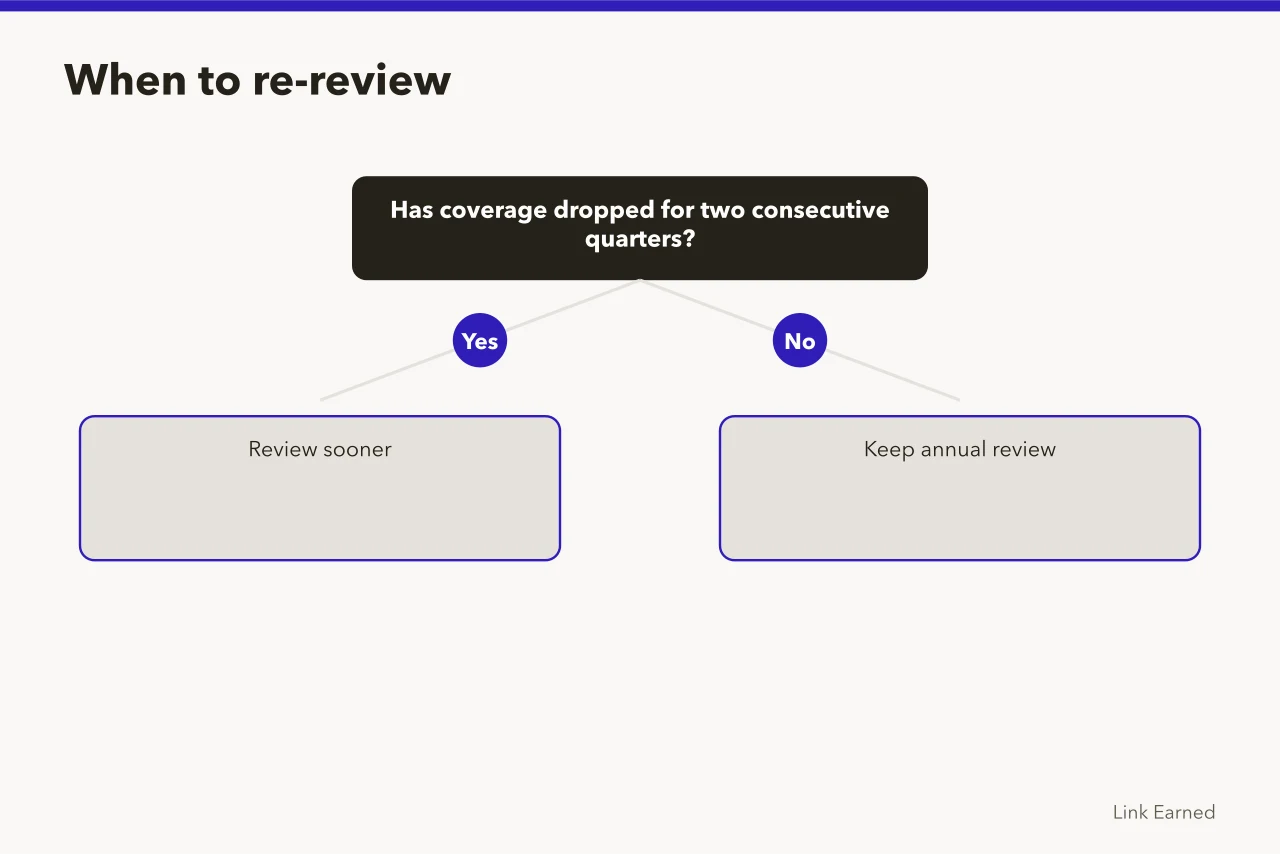
Re-reviewing is not disloyalty. It gives both sides a scheduled moment to reset scope and fees. Suppliers who resist a light annual review are telling you something useful.
Keep a rolling evidence file so the next review takes hours rather than weeks. Drop in quarterly coverage exports, invoice totals and any quality issues as they happen.
Give the supplier your score sheet before the review meeting. Sharing the criteria turns the conversation into a discussion about evidence rather than a negotiation about price.
Checklist for running a digital PR review
Use this before you shortlist, during scoring and before you sign.
Digital PR review checklist
- Define brief and outcome
- Agree criteria and weights in writing
- Request same evidence pack from all
- Verify five to twenty links independently
- Convert quotes to cost per link
- Check company register and ownership
- Confirm data and asset ownership
Digital PR review checklist
- Define the brief and the outcome you are buyingcoverage, links, awareness or all three.
- Agree criteria and weights in writing before contacting suppliers.
- Request the same evidence pack from every supplier.
- Verify five to twenty links independently in a third-party tool.
- Convert every quote to cost per placed link and cost per referring domain.
- Check the company register, ownership records and filing history.
- Ask for supply chain, certification and consent evidence.
- Search the advertising rulings database for upheld complaints.
- Speak to at least one former client as a reference.
- Confirm who owns the media list, coverage data and creative assets.
- Read the notice period and check for a performance break clause.
- Record scores with the evidence attached.
- Diarise the next review date.
A shortlist built this way is easier to defend internally and easier to explain if results disappoint. If you are still narrowing the field, our digital PR selection checklist in England covers the questions to ask on the first call, before you invest time in a full scoring exercise.
Common questions
How many suppliers should I compare?
Three to five is usually enough to see a range without wasting weeks. Fewer than three gives you no benchmark. More than five rarely changes the ranking and multiplies the evidence you must collect.
Should I score agencies and software tools on the same sheet?
No. They solve different problems and the criteria differ. Score tools on data accuracy, journalist database coverage and export limits. Score agencies on coverage quality, links and service. Run the two reviews separately, then decide how to split budget between them.
What if a supplier refuses to share raw data?
Treat it as a fail on the transparency criterion. You are buying an outcome and you need to verify it. A supplier that will not let you check the links it earned is asking you to take its word on the one thing you are paying for.
Can a small agency pass a full due diligence check?
Yes. Most of the checks are about answers, not certificates. A two-person agency can explain its ownership, its subcontractors and its consent practices. What it cannot do is hide behind a large brand name, which is often an advantage to the buyer.
In this guide
- Before you approve a digital PR review methodology, check these testsA practical review methodology for digital PR suppliers in England: what to assess, what to leave out, and how to score evidence without relying on vendor claims.
- How to vet digital PR providers with due diligenceA due diligence method for vetting digital PR providers, covering company records, supplier conduct, advertising rulings and campaign evidence.
- How to assess digital PR suppliers before signingUse a consistent digital PR process to compare data, delivery evidence, ownership and total cost before agreeing terms with a supplier.
- How to assess digital PR agency reviewsA practical digital PR review method: check Trustpilot, Clutch, G2 and Google reviews, verify evidence and understand UK rules on fake reviews.
- Digital PR selection checklist without the sales pitchA digital PR selection checklist for England: how to score suppliers on evidence, data protection, named roles and fees before you commit the budget.